
Building Costs Are Up, Now So Is Your Rate: What First Home Buyers Need to Know

Building Costs Are Up, Now So Is Your Rate: What First Home Buyers Need to Know Borrow less than the bank offers you, as building costs in Melbourne keep climbing, and the RBA lifted the cash rate to 4.60% on 29 September, so every extra dollar of build price now costs more each month. Most buyers chase the rate headline and overlook their loan size, yet a smaller loan protects you whatever the RBA decides next. Victoria’s stamp duty exemption and the $10,000 First Home Owner Grant can soften the blow, but only if you plan around them. This guide shows what the squeeze costs and how to use those incentives before you commit. The Double Squeeze Facing First Home Owners Most buyers blame interest rates alone, and they’ve got it backwards. Builders’ prices set the size of your loan, and the cash rate sets what that loan costs you. You absorb both hits at once, so treat them as one problem and budget for both together. The data backs that up. Nationally, house construction costs rose 2% in the June quarter of 2026 and now sit 51% above pre-pandemic levels, according to the National Housing Supply and Affordability Council. A 2% rise sounds small until you stack it on top of 51%, which is why last year’s quote deserves a second look. What a 4.60% Cash Rate Does to Your Repayments The RBA lifted the cash rate by 25 basis points to 4.60% on 29 September. That’s its fourth rise of 2026 and 100 basis points since the start of the year, per Commonwealth Bank’s decision summary. The Board also left the door open to further increases, so plan for that outcome, not for hope. Lenders also test your loan at a buffer above the actual rate. So your borrowing power shrinks even when your income stays put. Ask for a fresh pre-approval before you sign anything, because an approval from six months ago no longer reflects today’s reality. Want your own numbers? Book a free property analysis with us and find out what you can borrow safely, and which Victorian incentives you qualify for, before you sign anything. Get Expert Help Choosing Your Next Property Let’s Talk Now! The Monthly Cost of a Build Blowout These figures assume a 6.5% rate over 30 years, principal and interest, so treat them as a guide. An extra $50,000 on your build adds roughly $316 a month. A 0.25-point rate rise on a $600,000 loan adds roughly $98 a month. Every month of delay keeps your rent running while interest accrues on drawn funds. Together, those hits can swallow the buffer you planned for bills and savings. Which Victorian Incentives Can First-Timers Still Claim? Victoria still gives you a real edge. The State Revenue Office exempts eligible first-home buyers from stamp duty on homes up to $600,000, reduces duty on homes up to $750,000, and covers vacant land you buy to build your first home. The $10,000 First Home Owner Grant can sit on top of that saving when you buy or build a new home, provided your contract price stays at $750,000 or less. That cap shapes your design decisions as much as your budget, so confirm it before you pick a floor plan or a design upgrade. Structure matters, because in many land-and-build deals you pay duty on the land value rather than the finished house, so the savings can run bigger than you’d expect. Confirm both concessions and your contract structure with the State Revenue Office before you sign. Your Pre-Contract Checklist Run this checklist before you commit a cent. Stress-test your repayments at a rate one percentage point above today’s. Ask for a fixed-price contract and a clear list of inclusions. Query every provisional sum, because those figures move first. Hold a contingency outside your deposit for site costs and variations. Confirm your lender’s valuation supports the contract price. Confirm your contract price sits under the $750,000 cap for the First Home Owner Grant. Why the Cheapest Quote Rarely Stays the Cheapest A low headline price looks attractive when you compare builders side by side, but it often hides allowances that the final contract quietly shifts back onto you. Builders can keep a quote sharp by listing generous provisional sums, basic inclusions and optimistic site assumptions, then adjust the figures once work begins and you have already committed your deposit. You protect yourself by comparing contracts line by line rather than total by total, which means asking each builder to confirm what the price includes, what it excludes and which items remain estimates. A slightly higher fixed price with clear inclusions usually costs you less in the end than a cheaper offer that grows with every variation. Build Your First Home Around the Next Decade Most buyers treat their first home as a single purchase, yet it works better as the first move in a longer roadmap that shapes how much you can borrow, save and invest over the following decade. When you size your loan with that horizon in mind, you leave room to build equity steadily instead of stretching to the limit on day one. A disciplined plan also gives you a clear reason to say no when a design upgrade, a larger floor plan, or a rushed deadline pushes the budget past what you can comfortably carry. Buyers who hold that line tend to keep their finances flexible, which matters when rates, wages and construction prices move in directions nobody can predict. Need Help Finding the Right Residential property? Get Your Free Consultation Discipline Beats Hype When Rates and Build Prices Rise Here’s the principle: claim every Victorian incentive you qualify for, then set your budget by what you can carry at 4.60% and above, not by what a lender approves. Walk away from any deal that only works if rates fall. Forecasters disagree on when cuts arrive, and build prices won’t wait for them. Simply Wealth Group backs everyday Australians with property
Migration Is Outpacing New Builds — Here’s What That Means for Investors

Migration Is Outpacing New Builds — Here’s What That Means for Investors Most investors read the shortage headlines and hear “guaranteed win”. They’ve got it backwards. Even after easing, migration growth in Australia still added 292,100 people in the year to March 2026 (per the ABS), while building trails was the national target. The short answer: the supply gap props up rents and long-term demand, but it won’t rescue a badly bought property. With the RBA cash rate now at 4.60%, discipline beats the story every time. Smart investors treat the gap as a chance to buy carefully, not rush. This post shows where demand lands first, why approvals mislead, and how to build a portfolio that survives higher rates. How Big Is the Gap Between Migration and Supply? The ABS puts population growth at 392,700 people in the year to March 2026. Net overseas migration supplied 292,100 of them, down from 309,500 the year before. That’s cooler, but it’s still a heavy load for a housing system that isn’t building fast enough to house new arrivals and existing households alike. Demand keeps arriving whether construction is ready or not. The supply side looks worse, as the National Housing Accord targets 1.2 million homes between July 2024 and June 2029. Government advisers now expect it to land around the end of 2030, according to the ABC, and Master Builders forecasts a 204,000-home shortfall. That’s a gap of years, not months, and no single policy announcement closes it quickly. Where Does Migrant Demand Show Up First? In rentals, as newly arrived residents typically rent before they buy, Cotality’s June quarter data shows national rents up 5.9% over the year. Vacancy sits at 1.6%, with every capital below 2%. Tenants compete for scarce listings, and landlords with well-located properties benefit from that pressure through higher, more reliable income. That’s the real engine behind the shortage story. That income only holds if someone manages it properly. A strong property management service in Australia screens tenants, prices rent to the market and keeps vacancy short, because empty weeks quietly wreck cash flow. Simply Wealth’s specialists do exactly that, and each proposed investment comes with a rental guarantee, which takes pressure off new investors. Get Expert Help Choosing Your Next Property Let’s Talk Now! Why Don’t Approvals Solve the Shortage? Approvals make good headlines, but nobody lives in an approval. The ABS recorded 17,687 dwellings approved in July, a 3.6% monthly fall, though still 9.0% above a year earlier. Treat that number as a signal of intent rather than delivery, because approved projects still need finance, labour and materials before anyone gets keys. Approvals are the starting gun, not the finish line. Higher rates squeeze builders and developers as well as buyers, and the RBA lifted the cash rate to 4.60% on 29 September, its fourth rise this year. If you’re planning a build rather than buying established, read our guide on what rates at a 15-year high mean for your build budget. Approvals lead, completions lag, and the shortage lives in that lag, which keeps pressure on rents. What Do Most Investors Get Wrong? Most investors chase the shortage story. Disciplined ones check these four things first: Treating a national shortage as a local guarantee: A weak location stays weak in a tight market. Ignoring holding costs: If a property only works when rates fall, it isn’t a strategy. Chasing the headline suburb: Crowded postcodes inflate entry prices and squeeze your yield. Skipping the roadmap: One purchase isn’t a portfolio, and sequence matters. Not sure your next purchase passes the numbers test? Book a free property analysis with Simply Wealth Group and get a straight answer before you commit. Investing Through the Gap Build for the long run, not the news cycle: Buy for cash flow you can carry today, then stress-test it against higher rates. Choose areas with jobs, transport and proven rental demand, not just a low entry price. Plan your next three purchases, not only the first. Keep a cash buffer for vacancy and repairs. The Shortage Is Real, but Discipline Still Pays Here’s the takeaway. Net overseas migration and slow construction give Australian property a solid demand floor, but a floor isn’t a return. Buy well, hold comfortably, and build a roadmap you can follow when the headlines change. Investors who set rules early and stick to them through rate rises are usually the ones still holding quality assets years later. Simply Wealth Group is a property investment group in Australia built around full-time property investors with proven results who value personal sense, not just financial sense. Its team covers property advisory, mortgage solutions, portfolio management and education under one roof, so your strategy stays joined up from first purchase to the next. Ready to build your roadmap? Book a free property analysis today. Need Help Finding the Right Residential property? Get Your Free Consultation FAQs: Will slow supply guarantee my property grows in value? No, as a shortage lifts demand broadly, but location, purchase price and holding costs decide your result. Weak areas stay weak in a tight market, and overpaying for a strong area still drags on returns. Check local demand before assuming the national story fits your street. How should I stress-test a purchase at 4.60%? Run the numbers at a cash rate one to two points higher and confirm you can still carry the loan comfortably. If a deal only works when rates fall, walk away. Keep a buffer for vacancy and repairs, because a plan with no room for surprises isn’t a plan. Is a rental guarantee enough protection against vacancy? It helps, but read the terms before you sign. Vacancy is an average, and your property sits on one street. Ask what the guarantee covers, how long it lasts and what happens when it ends, then judge the property on its own rental merits. Should I buy new or established in a supply-short market? New builds add supply and can carry depreciation
Locking In Today’s Price: Why Timing Matters More Than Ever in This Market

Locking In Today’s Price: Why Timing Matters More Than Ever in This Market Most investors get timing backward, as they wait for established prices to fall, then watch building costs rise. Timing matters more than ever because the market is splitting: Melbourne values are softening, yet the ABS says new dwelling prices rose 5.7% in the year to July 2026. Any property investment firm in Melbourne worth trusting will tell you to plan, not predict. That does not mean rushing in, as a locked price guarantees no growth, and it never replaces solid strategy. It removes one specific risk: paying more later for the same home. Nobody should buy on fear, but everybody should understand what a delay actually costs them. Is the Market Really Falling Everywhere? Not quite, as Melbourne dwelling values fell 1.1% in August and now sit about 6% below their November 2025 peak, per Cotality. Nationally, values have slipped five months in a row. Across the capitals, 93% of suburbs recorded a fall through winter. Established buyers have room to negotiate. Most commentary stops there. New homes tell a different story. The ABS says builders raised base prices to pass on higher labour and material costs. Run that 5.7% over a $700,000 package, and you get about $39,900 a year, or roughly $3,300 a month. Land does not always move in step with build costs, so treat that as an illustration, not a forecast. Get Expert Help Choosing Your Next Property Let’s Talk Now! What Is the Real Price of Waiting? The brochure price is only part of the bill, and most buyers discover the rest too late. Delay does not just raise the sticker price. It quietly stacks extra costs on top, and each one lands in your pocket rather than the builder’s. Four pressures matter most: Escalation clauses: builders increasingly write them in, so today’s quote may not be your final price. Valuation gaps: if costs outrun the bank’s valuation, you cover the difference in cash. Borrowing capacity: three RBA hikes this year lifted the cash rate to 4.35%, and each further rise trims what lenders offer. Holding costs: delays leave you paying rent and a mortgage at the same time. Who Do the New Tax Rules Actually Favour? Parliament passed the changes in June. From 1 July 2027, rental losses on established homes bought after 7:30 pm on 12 May 2026 can’t offset your salary. New builds keep negative gearing. The 50% CGT discount is replaced by indexation and a 30% minimum tax on gains. Source Canberra designed that carve-out to steer investment toward new supply, which favours house and land packages in Melbourne over established stock. Not every new build qualifies, though. Knock-down rebuilds do not, so confirm eligibility with your accountant before you sign, and read the fine print on any project you consider. Want to see what a locked-in price looks like for your numbers? Book a free property analysis with Simply Wealth Group. Is There a Disciplined Way to Lock In Your Price? Yes, and it looks nothing like panic buying. Discipline means a checklist, not a countdown clock. You refuse any deal that only works if everything goes right, and you test every assumption before you sign. Work through these four steps in order: Fix your finance first: test your borrowing capacity at higher rates before you look at any lot. Price the whole project: land, build and site costs each carry their own risk, so add them together. Scrutinise the contract: provisional sums can blow out, so ask what stays fixed. Stress-test your cash flow: run repayments one percentage point above today’s rate, and proceed only if the numbers hold. Need Help Finding the Right Residential property? Get Your Free Consultation Can You Afford to Wait for the RBA? You can try, but you are betting on something nobody controls. Markets expect the RBA to lift the cash rate again at its 29 September meeting, and the ABS puts annual inflation at 4.60% for July. Even if the RBA pauses afterwards, the board says it remains focused on preventing high inflation from becoming entrenched. You can refinance a loan when rates ease, as you cannot go back and buy at last quarter’s price. Waiting feels safe, but it is still a decision, and it carries a cost. Disciplined investors rarely wait for perfect conditions. They set a strategy, protect what they can control, and let time do the compounding. Price You Lock In Is the Only One You Control Nobody rings a bell at the bottom of a cycle. Rates, values and tax settings will keep moving, and property investors in Melbourne who wait for certainty usually end up paying for it. The build price in your signed contract is the one number you can fix today, while everything else stays open. The principle is simple: protect the cost you can control, stress-test the rest, and hold for the long term. That is a roadmap, not a rush. Set it once, review it yearly, and resist every headline that tells you to abandon it. Simply Wealth Group helps everyday Australians build high-performing property portfolios. Our Melbourne-based team invests full-time and guides you every step, from property strategy to mortgage solutions and project management. Explore more at https://simplywealthgroup.com.au/. Ready to lock in your price? Book your free property analysis or call us today. FAQs: How does Simply Wealth Group approach a first purchase? We put strategy and finance ahead of stock. Your finance broker and wealth strategist matter more than any one property, and our team invests full-time, so the numbers must work first. That reflects our view that ethical advice gives you more than just numbers to decide on. Why do values fall while build costs rise? Established values follow borrowing capacity and rates. Build costs follow labour and materials, which builders pass on, while infrastructure and energy projects compete for skilled trades. That is why cheaper established stock and dearer new builds can sit side
Why Our House and Land Prices Are Rising — and What It Means If You’re Planning to Buy

Why Our House and Land Prices Are Rising — and What It Means If You’re Planning to Buy “The market” gets blamed for increases in price, and the people just wait around until “the market” turns back down. This never works. Shortages of land, delays in development, and an unwilling Reserve Bank to cut interest rates are all causing prices to increase quicker than many buyers expect, and nothing is turning back soon. If you are deciding between house and land prices in Australia at the moment, here’s the bottom line: Prices are going up because there is not enough supply to meet the demand, and buyers who know why prices are going up will come out better off. Here’s the truth of it. What Is Actually Driving the House-and-Land Values Up Now? Let’s begin with interest rates, just as everyone else does. Market expectations have actually firmed significantly beyond a simple possibility, with a hike to 4.60% now priced in as a near certainty. ASX RBA Rate Tracker place the probability of a 25-basis-point increase to 4.60% at over 80% to 93%. If you are planning on cheaper financing to bail you out, then you are gambling on something that even the Reserve Bank hasn’t decided on yet. Next up comes supply. By mid-September, market pricing had indeed moved toward a hike; most trackers had it in the high-70s to high-80s per cent range for a move to 4.60% at the September 29 meeting (helped along by a hot US jobs report and a Fed hike mid-month). But the “priced into the market” framing understates how split the actual forecasters are: NAB has been out front calling September as its base case, while ANZ and CBA have stuck with November, and Westpac’s position has moved around depending on which week’s note you read; it was the lone holdout for a while before some sources had it flip to September too. Get Expert Help Choosing Your Next Property Let’s Talk Now! Are Land Prices Rising Faster Than Building Costs? Mostly yes, in growth corridors, and that is precisely the part buyers often misread. The cost of titled land in established estates is the tightest bottleneck in the supply chain at present, with developers staging their projects much more conservatively than the demand requires. ABS figures show the average value of approval for a new home is over $517,000, up around 5% from the previous year. So, building costs are rising, but scarcity of land is generally the bigger factor in growth corridors outside the metro area. That is where most buyers get their priorities completely reversed. Instead of thinking about the total cost of buying the land they will build on, they tend to focus purely on the cost per square meter of the build and neglect the land part, which is precisely where the premium will be after the estate has matured. If you wish to have an honest conversation about growth corridors that still have some value left, the best time would be before the deposit is locked in. Should You Wait Until the Market Prices Have Cooled Down to Buy? Not waiting is not a plan, but a gamble, and not necessarily a good one when demand exceeds supply. The majority of people who “wait for things to cool down” end up buying two years from now at a higher price, and with even more leverage, than before. Here’s what normally occurs during your wait: The release of land in the subsequent phase is more expensive, as supply has failed to catch up. Interest rates stay high for longer than advertised, subtly eating away at any savings. Building costs continue to pile up each month, directly affecting the bottom line of construction costs. Your ability to borrow shrinks as income growth lags behind price growth What Does This Mean for Property Investors in Australia? For property investors in Australia, increased land and build costs mean a different equation. The game isn’t about playing with the lowest deposits possible or the most attractive rent yield prediction, but about looking for areas with restricted supply due to actual population growth rather than a prediction in a slide deck. Those who have structured their finances with some leeway, and not stretched their budget to the limit of what the bank is willing to lend, are the ones who remain standing after this rate cycle. Good structure wins out over good hopes of a rate cut, which has yet to happen. How Should You Make Your Buying Decision in This Market? Think twice before you put pen to paper and get the numbers straight before you make any commitments: Compare the price of the land to the last three real settled sales, not indicative listing prices, in the estate. Always allow yourself a buffer of at least 10% for changes in building costs. Arrange your financing ahead of time with a rate rise test, not current rates. Stay away from contracts that have uncertain site cost conditions. Make sure of the builder’s track record in completing houses after the day of settlement. Need Help Finding the Right Residential property? Get Your Free Consultation Why Is Property Management Important After Settlement in Australia? It’s only part of the story, as after the property settles, it’s property management in Australia that will decide if the profits on paper become real. The length of vacancy, the type of tenants, and lack of maintenance cut into profits far quicker than expected. Even when a property has been purchased wisely, mismanagement will reduce its performance, sometimes seriously. Manage the investment with the same consideration that was taken into the purchasing of it, for it’s the management that makes the difference. Prices Are Not Going To Wait For You Don’t use rising prices as a reason not to invest. It is a sign of a disrupted supply chain, and inaction comes at a price. Those investors who act on discipline and not emotions and FOMO
How Property Investment Can Legally Reduce Your Tax Bill

How Property Investment Can Legally Reduce Your Tax Bill Property investment can legally reduce your tax bill when eligible expenses, depreciation and other deductions are claimed correctly under Australian tax rules. But a tax deduction is not a reason to buy a property that does not make financial sense. For investors considering a property investment company in Australia, the disciplined approach is to assess the property, finance, rental income, cash flow and portfolio role first, then understand the tax treatment. For Australian investors, this keeps tax planning connected to the broader investment strategy rather than making it the sole reason for a purchase. Why Tax Planning Should Start Before You Buy Tax should not be something you consider only after settlement. The structure of an investment and use of borrowed funds can affect what may be claimed. The Australian Taxation Office states that rental income must be declared and that many, but not all, rental property expenses may be deductible. Some expenses can be claimed in the income year incurred, while others must be claimed over several years. Expenses may also need to be apportioned when a property is privately used, or a loan has investment and personal purposes. A tax-focused approach gives investors a framework for discussing property selection, finance, ownership and tax treatment before committing capital. What Property Expenses May Be Deductible? Investment properties involve ongoing costs, and some may qualify for deductions when they meet the requirements. Examples include eligible loan interest, property management fees, insurance, council rates, advertising and certain maintenance or professional expenses. Do not treat every expense as automatically deductible. Repairs and improvements can receive different tax treatment. A repair generally restores an item, while an improvement may add value or extend its useful life. Good records make this easier. Keep: loan statements showing how borrowed funds were used; invoices and receipts for repairs, maintenance, and improvements; and property management statements and insurance records. Depreciation Can Support the Tax Position Eligible building costs and depreciating assets may provide deductions over time, subject to the applicable rules. Depreciation can reflect a decline in value without the same cash outflow during the year. Get Expert Help Choosing Your Next Property Let’s Talk Now! A qualified quantity surveyor can prepare a depreciation schedule identifying relevant amounts for your tax professional. For investors comparing a property investment company, weigh depreciation alongside price, rental demand, financing and portfolio role. Negative Gearing: Understand the Trade-Off Negative gearing is often discussed as though it is a benefit without a cost. That is too simple. A rental property is generally negatively geared when deductible expenses are greater than rental income. Under applicable rules, the resulting rental loss may be deductible against rental and other income. If other income is not enough to absorb the loss, the ATO states that the loss may be carried forward. The tax outcome can reduce taxable income, but the investor still has an underlying cash shortfall. Negative gearing should be treated as one part of an investment structure, not the investment strategy itself. The property still needs sound fundamentals: price, rental demand, financing, costs, location, and suitability for the investor’s goals. What the 2027 Changes Mean for Investors Federal reforms make tax planning more relevant. From July 1, 2027, negative gearing for residential property will generally be limited to eligible new builds. Established residential properties purchased after 7:30 pm AEST on May 12, 2026 will generally have rental losses treated differently, with deductions against non-residential income restricted under the new framework. For Australian investors, the established-versus-new-build decision deserves attention. It does not mean a new build is automatically the right choice. Price, location, construction, rental demand, financing and strategy still matter. The above reflects the rules as at the time of writing and is correct as at publication date; confirm current settings with a tax professional before purchasing. Building a Tax-Aware Property Management Portfolio A property management portfolio should be assessed as a connected strategy, not simply a list of properties. Each asset contributes different rental income, expenses, financing requirements, and risks. As a portfolio grows, reviews can help assess whether the strategy still fits. Income, interest rates, rental conditions, expenses, and legislation can affect individual properties. Investment advisors can add value here. Their role should be to connect property selection, finance, portfolio planning, and long-term objectives. Tax advice itself should come from an appropriately qualified tax professional. A disciplined review can include: checking rental income against ownership costs; reviewing debt and finance structure; and considering whether a new property strengthens the portfolio rather than simply increasing its size. We takes an integrated approach across property investment, mortgage solutions, portfolio management and related support. Its services are built around education, guidance and ongoing investment support. [Get Portfolio Guidance From Simply Wealth Group] Tax Benefits Should Support the Investment, Not Drive It The biggest mistake is treating a tax saving as proof that an investment is good. It is not. If an investor spends money to create a deduction, the deduction does not erase the expense. The better question is whether the property makes sense before tax and whether its role in the portfolio remains appropriate after tax. For anyone researching a property investment company in Australia, ask how the strategy is developed, how properties are assessed, how finance is structured and what support continues after settlement. Good advice should challenge assumptions, explain trade-offs and make the numbers easier to understand. Capital Gains Tax Also Matters If an investment property is later sold, Capital Gains Tax may apply on the difference between the sale proceeds and the property’s cost base, which includes the purchase price plus eligible acquisition and improvement costs. Investors who have held the property for more than twelve months may be eligible for a CGT discount, subject to individual circumstances and the rules in effect at the time of sale. Timing the sale matters too. A property purchased before or after the May 2026 negative gearing cutoff may carry a different tax profile at
House and Land in Beveridge | Full Turnkey Home $693,250
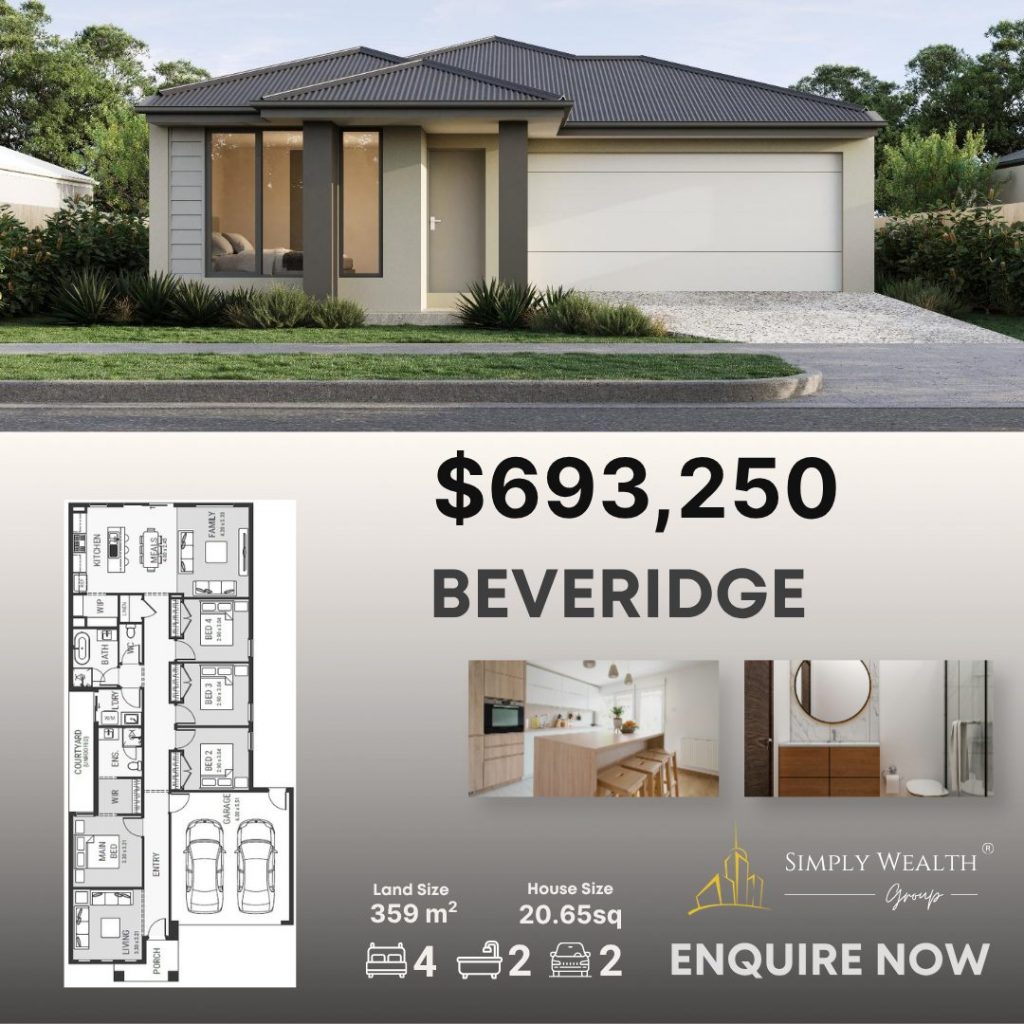
Explore this modern 4-bedroom house and land package in Beveridge. Featuring a full turnkey finish, quality inclusions, family-friendly design, and excellent long-term investment potential, this home is ideal for first home buyers, families, and investors seeking value in Melbourne’s growing northern suburbs.
Townhome in Clyde North | Full Turnkey Home from $558,220

Townhome in Clyde North. Discover a modern townhouse in Clyde North featuring a full turnkey 2-bedroom home with premium inclusions, low-maintenance living, and strong investment appeal.
House and Land in Beveridge | Turnkey Family Home from $672,100

House and Land in Beveridge. Discover a premium house and land in Beveridge featuring a modern 4-bedroom turnkey home with full inclusions. Ideal for first home buyers and investors.
House and Land in Beveridge | Turnkey Investment Property from $701,650

House and Land in Beveridge. Discover a premium house and land in Beveridge featuring a modern 4-bedroom turnkey home. Ideal for families and investors seeking growth and affordability.
Advice for Young First Home Buyers

Unsurprisingly, one of the biggest hurdles for young people getting a mortgage is affordability. Melisa Sloan, founder of Madison Sloan Lawyers and author of Big Moments said that high demand and property shortages make things even tougher. “The biggest hurdle is affordability and obtaining finance in an environment where property prices, particularly in city areas are relatively high. Saving for a deposit and the ability to service a mortgage has increasingly become difficult for young people over the past two years, with many now reliant on parental or other family help to obtain a mortgage and get into the property market,” said Sloan. “Many people with good jobs and the ability to service a loan find themselves unable to obtain a mortgage because they do not have a sufficient deposit that is required by lenders. Additionally, property shortages continue to make it difficult for people for young people to get a mortgage.” You may read the whole article here:https://bit.ly/4d1mYQg