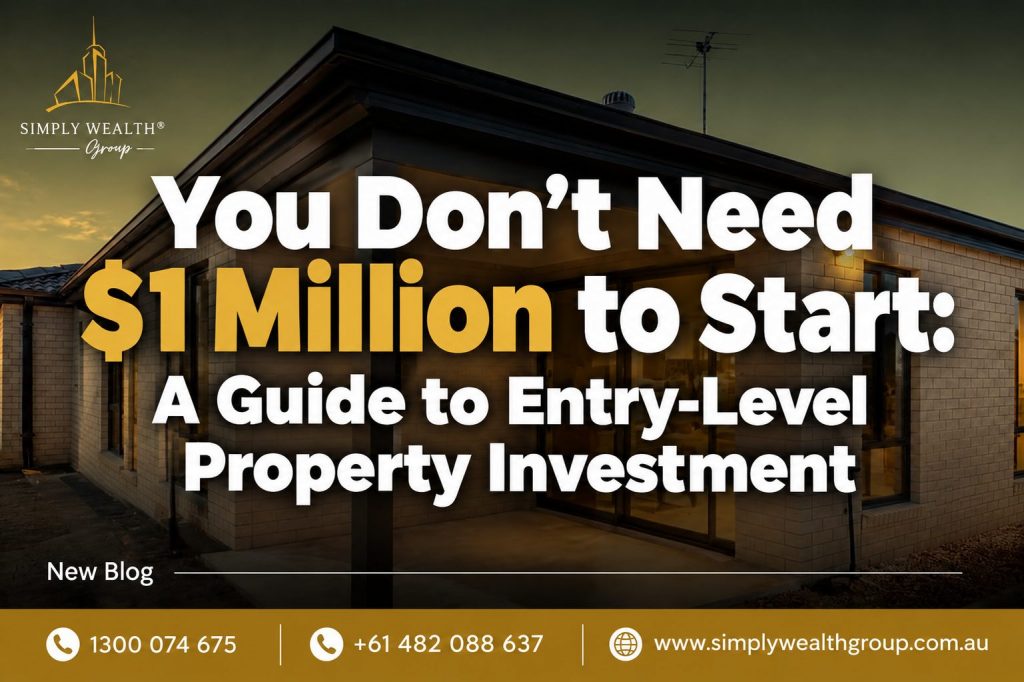
You Don’t Need $1 Million to Start: A Guide to Entry-Level Property Investment
Somewhere down the line, the idea emerged that property investment is something reserved for the wealthy; you have to have either $750,000, a trust fund, or an unexpected windfall of money in order to “qualify” for property investment. This couldn’t be further from the truth and has kept many competent individuals from entering the market unnecessarily.
The point isn’t the size of your savings account but having a realistic deposit, good borrowing options, and a plan that’s not based on luck. Anyone running a reputable property investment company in Australia will confirm this after all the marketing hype is stripped away.
Why Is The “One Million Dollar Rule” Here To Stay?
Because it’s easy, and stories are easier to spread than facts. News media focus on luxury properties in the eastern suburbs of Sydney or the inner ring suburbs of Melbourne, because that makes news. That doesn’t make news is the investor who purchases a modest three-bedroom property in a growth region for less than a fraction of that cost and lets time, rent, and debt management take care of the rest.
That’s the contrarian part most people don’t like to say out loud: sometimes it’s better to start with something small than with something big. Because when someone stretches himself for their first purchase, there’s nothing left for his second, third, or fourth investment. And discipline always trumps size; after all, it’s not about the size of the asset one owns from the get-go, but about owning something at all.
How Much Does It Really Cost to Buy Your First Investment Property?
Put away the myth about a million-dollar deposit. Here is what really dictates whether you can buy your first investment property this year:
- A deposit of about 10-20% of the purchase price, although some lenders may require less depending on the state and government scheme.
- Stamp duty, which varies between states, but may be partially or fully exempt for certain eligible borrowers.
- Lenders Mortgage Insurance (LMI), which you will have to pay if your deposit falls below 20%, although this may be rolled up in your loan amount.
- The capacity to service your loan, calculated by a lender based on your ability to make payments given the interest rates and your debts and earnings.
- Cash reserve for contingencies.
How Much Deposit Do You Really Need?
On a $500,000 starting home, 10% comes to $50,000, which is not $1 million, nor even close. Factor in stamp duty and borrowing fees, and the real cost that a lot of first-time investors need to get into a place will be around $60,000-$80,000, depending on the state and property types.
The cost is still not a small amount, and pretending it is not does not change that reality at all. This is precisely when a property investment advisor will prove their value, as opposed to the magic trick they do not have, by crunching the numbers based on what would happen if interest rates go up, there is vacancy, and what you can borrow.
What Locations Should Beginners Focus On, and What Ones Should They Avoid?
The choice of location becomes particularly important when you enter real estate investments, since you can’t afford to make mistakes. Some guidelines that might come in handy:
- Select locations that offer a diversified workforce, rather than places that depend on just one company or mine as their source of livelihood.
- Select locations that offer existing commitments towards infrastructure development (transportation, hospitals, schools), rather than promises only.
- Focus on real estate that suits tenants’ needs (houses close to schools, units close to public transportation, not just “lifestyle” property).
- Stay away from locations which suffer from oversupply and lack of rent growth due to competition from the existing stock.
- Make sure to research vacancy rates and yield in a particular suburb and not in the entire city.
This type of analysis is easily done and easily misunderstood. If you wish to know what your borrowing capabilities are before you even begin viewing properties, make an appointment to receive a free strategy session to learn about the real numbers.
Is It Really Safer to Go for a Cheaper Property?
Sometimes not, especially when beginner-friendly tips become destructive. There is no direct relation between cost and safety in real estate deals. An investment at $350,000 in a town that is experiencing depopulation and has only one company could be more dangerous than an investment at $550,000 in a city where people are willing to rent apartments and there are diverse industries.
The price is just one of many factors. The thing that will ensure a newcomer’s safety is the ability to choose the property that will generate income based on fundamentals, such as land value, demand from tenants, and the growth drivers, rather than on the price.
How Can You Sidestep the Entry-Level Rookie Errors?
While many entry-level investors fail due to the fact that they picked the wrong suburb to invest in, most make the mistake of believing that buying a piece of real estate is the result and not the beginning of their investment journey. Property investing favors individuals who look ahead to the next five or ten years, not the next open house.
This includes implementing proper property management right from the start, handling cash flow correctly, and creating a real property management portfolio, as opposed to an isolated purchase that you hope works out. A properly managed property that you review each year allows you to buy your second property easily.

Small Deposit, Large Discipline: Your Actual Starting Point
$1 million is not important, but a sensible budget, a profitable property, and the discipline to follow the plan even in a noisy market environment are. That is all there is to the game; no magic, not perfect timing, but rather sensible decision-making.
The team at Simply Wealth Group has been working for many years to help Australians overcome the idea of having $1 million and invest in the first-ever researched property. Whether it is strategy development, negotiating process, or further management of your investment property, our team is guided by actual market information at all stages of the process.
Contact us for a free property strategy session now.
FAQs:
What is the minimum realistic deposit required for a first investment property in Australia today?
Although most banks require 10-20% of the purchase price, there are some government programs that may reduce this amount for certain eligible buyers. For a house costing $500,000, this would mean a deposit of roughly $50,000, with total upfront costs, once stamp duty and other transaction costs are included, typically landing between $60,000 and $80,000.
Should new investors invest in their own city, or should they consider investing interstate?
Investing in your own city is not necessarily the best option. The factors to consider include affordability, the level of diversity of employment opportunities, in addition to the growth drivers of the particular location.
How many properties can one expect to own after ten years of owning one entry-level property?
It depends on the growth rate, rental yield, serviceability, as well as the management of the initial investment property.
Is there a need for professional advice prior to purchasing the first investment property, or is it enough to conduct research?
Research gives an overall idea; however, it does not test the unique borrowing capacity, taxation, and risk-taking capacity of the buyer as professional advice would do. For example, the main principle of the Simply Wealth Group is to calculate these factors before the client decides to make an offer.
What is the greatest financial mistake of new property buyers in their first year of investing?
The main mistake of first-year investors in real estate is the underestimate of holding costs, interest, insurance, maintenance, and vacancy costs; not the price of the property itself. Creating a financial reserve before settlement is important, as well as depositing the money.
Chat with Simply Wealth Group
Simply Wealth Group
1300 074 675
WhatsApp: 61468175628
marketing@simplywealthgroup.com.a